Haunted history
Why Savannah is so haunted
“America's Most Haunted City”
In October 2002 the American Institute of Parapsychology held a conference in Savannah and declared it “America's Most Haunted City,” as the Associated Press reported at the time. The title was accepted on the city's behalf by Shannon Scott, a local ghost-tour founder.
The institute's founder, Andrew Nichols, said the designation was more honorary than scientific: “If I had to name the most haunted city, Savannah would be right up there. There are old structures that are relatively unchanged and haven't been moved from their original locations. You've had a lot of people living and dying in Savannah.” New Orleans, Chicago, Philadelphia and Charleston claim the title too.
A city built on its dead
Colonial Park Cemetery was the city's main burial ground from 1750 to 1853. It holds more than 9,000 graves and was the city's burial ground through the deadly yellow fever epidemic of 1820. Savannah grew around and beyond its old burial grounds, too: City of Savannah research places an early burial ground for Black Savannahians near today's Whitefield Square and the “Strangers Burial Ground” beside Taylor Square (formerly Calhoun Square). Both were replaced in the 1840s, but not every grave was moved: a local historian told WTOC that a utility crew digging at the square's southeast corner in 2004 unearthed a skull.
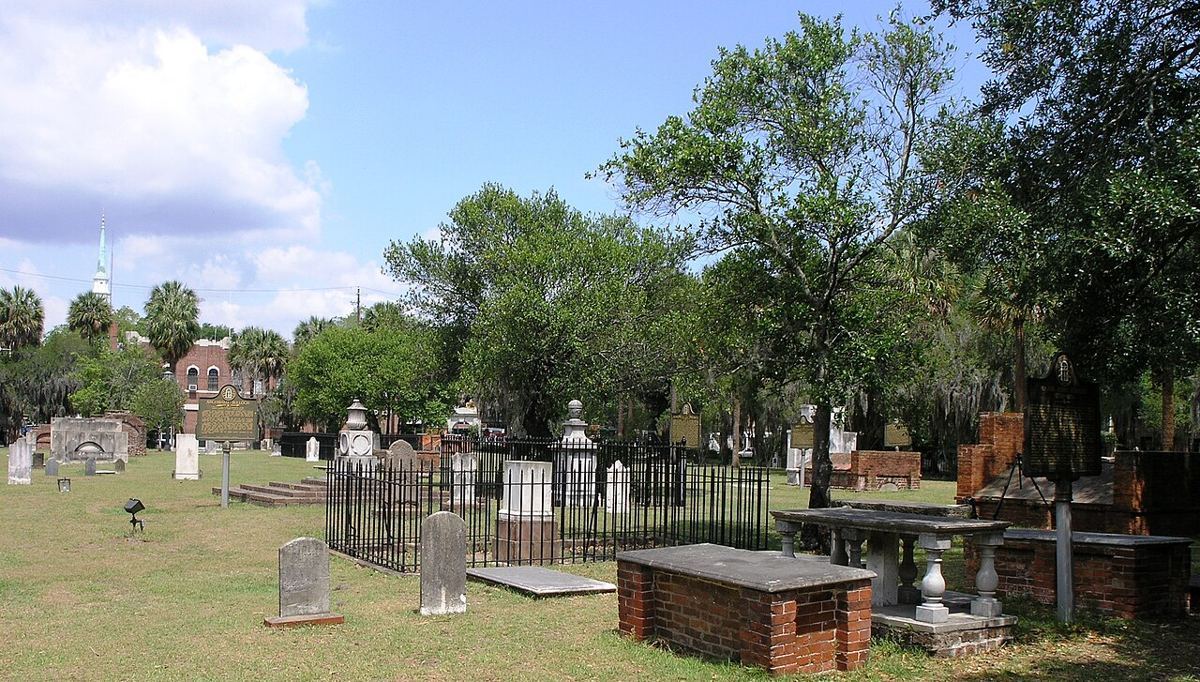
Photo: Daniel Mayer · CC BY-SA 3.0 · via Wikimedia Commons
Fever, fire and war
Yellow fever killed more than 700 people in 1820 and about 1,000 in 1854; the National Park Service says the 1820 outbreak killed a tenth of the population. Fires in 1796 and 1820 each left about half the city in ruins. In the Siege of Savannah in October 1779, one of the bloodiest battles of the Revolution, the allied French and American attack failed with heavy losses near today's Spring Hill Redoubt. Many of the ghost stories grow from these years.
Bonaventure and the city cemeteries
Bonaventure Cemetery, on a bluff above the Wilmington River, became a private cemetery in 1846 and a city cemetery in 1907. Its moss-hung avenues and statuary became world-famous through Midnight in the Garden of Good and Evil. The famous “Bird Girl” statue from the book's cover was moved to the Jepson Center. Laurel Grove and Greenwich are city cemeteries too.
The City of Savannah asks visitors to treat its cemeteries as sacred sites, not haunted attractions, and to respect families visiting graves. City cemetery gates are open 8 a.m. to 5 p.m. daily (Colonial Park stays open until 8 p.m. in the warmer months). Ghost tours tell the cemetery stories from outside the gates.
Famous haunts in the app
Each of these has its own page with the stories the tours tell and the tour companies that tell them:
- Sorrel-Weed House
- The Marshall House
- Mercer Williams House
- 432 Abercorn Street
- Kehoe House
- The Pirates' House
- The Olde Pink House
- 17Hundred90 Inn
- Hamilton-Turner Inn
- Andrew Low House
- Davenport House
- Foley House Inn
Or see every haunted site on the Haunted page.
Sources
- Associated Press via Lawrence Journal-World: “Savannah named most haunted city” (Oct 13, 2002)
- Chicago Tribune via Seattle Times: “Spinning ghostly tales in Savannah” (2007)
- City of Savannah: Colonial Park Cemetery
- City of Savannah: Bonaventure Cemetery
- City of Savannah: Cemeteries FAQ
- City of Savannah Municipal Archives: Savannah’s “Negro Burial Grounds” and “Strangers Burial Ground” (2021)
- WTOC: Historian, guide offers clues to Calhoun Square’s past
- New Georgia Encyclopedia: Savannah
- National Park Service, Fort Pulaski: Savannah